Wednesday, July 31, 2013

Counterpoint Lession 7: Free counterpoint

Free counterpoint

Part I - Free Counterpoint
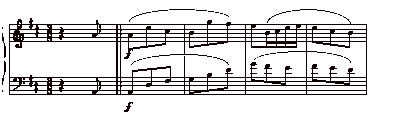
Free counterpoint combines all the other species into one.  In this type of counterpoint, one is able to have note-against-note, two against one, three against one, and four against one.  Although not as common, it is possible to have two against three, and three against four.
Fig.1 Free counterpoint

Notice that there exists 3:1 and 2:3, as well as 2:1 in this example. 
Part II - Simple two-reprise Form
Also known as binary form, This most commonly exists as simple dance movements, Such as gigues1 or sarabandes2.  Two-reprise pieces most commonly exist in sixteen, or twenty-four measures, The layout of the piece often looks like this:

||:8 measures:||:8 measures:||    and       ||:8 measures:||:16 measures:||
       Tonic                     Dominant                                             Tonic                      Dominant
Even though the piece modulates for the second part, the overall feel of the piece does not shift (i.e. major/minor, tempo, etc.)  Although the general feel of a piece does not change, it is  normal to see a piece change tonality between the two sections.To facilitate this shift, the last measure of each section often tonicizes to the new tonic of the next section.  Like this:

Major:                                                       minor:
||:I             V(iii):||        ||:i              v(V, or III):||

An example of the simple two-reprise form can be found in Bach's Minuet in d minor, BVW Anh.132
 
Notice that in the second part, the tonality shifts in the second part of the piece.

___________________________________________________________________________________________________
1. Gigue:  A lively dance piece of the Baroque and Renaissance, usually in compound meter. 
2. Sarabande:  A dance movement in triple meter (most commonly3/4, 6/8, and even 9/8) 

Counterpoint Lession 3: General characteristics of counterpoint

General characteristics of counterpoint

Part I - foundations of Baroque polyphony
The Baroque period especially had strict rules for consonance and dissonance. composers in the Baroque era learned the techniques of the preceding Renaissance.  Early Baroque music was simple, only two voices.  Usually in the form of instrumental music.  Most often, this early Baroque music was not-against-note.  There was sometimes simple elaborations in the melody lines. If a passage was repeated, it was understood that the second time should be highly embellished.

Counterpoint Lesson 2: Melody

Lesson 2:  Melody


Part I - Tempo, Meter, and Phrasing
During the Baroque era, all of these aspects would remain unchanged throughout the course of the piece.  i.e. if a piece began in a minor key, it remained so for the entirety of the piece.  Tempos rarely changed in the middle of a piece either.

Part II - Vocal instrumental cross influence
Often in Baroque music, vocal music imitated instrumental music.  And vice versa. 

Part III - Features of Baroque Melody
The biggest distinguishing feature of Baroque melody is the idea of devolping melodies and counter-melodies.  Many times in music before the Baroque era, melodies were not developed or expanded on.  At least not often.  Another big feature of Baroque music is the idea of sequences.

 Fig.1 sequence
Notice that in the upper voice, there is an ascending figure of four eighth notes.  This is known as a sequence, and is extremely common in Baroque music. 

Counterpoint Lession 6: further diminutuion

 further diminution


Part I - Further contrapuntal diminution
The slower moving cantus, is often elaborated to bring out the accompanying counterpoint.  It is often 3:1, or 4:1 (three notes against one, and four notes against one). Instances of 'free' rhythmic counterpoint is also often.  Shown here is an example of third species counterpoint.

Fig.1 third species counterpoint.

Notice that there are four notes against one in third species.  In fourth species, also known as free counterpoint, there are instances of upwards of ten notes against one.  

Here, in fourth species counterpoint, there are combinations of all of the other species.  This is by far the most common type of counterpoint.

Notice that the first note of each group of four sixteenth notes ascends by step, just as the quarter notes do in the cantus.

Part II - the two-voice Chorale Prelude
Using a German chorale tune as the cantus firmus formed much of the vocal repertoire in the Baroque period.  Here in this chorale prelude, the tune "Wachet auf ruft un die stimme" is used as the cantus firmus.  


Tuesday, July 30, 2013

Counterpoint Lession 5:simple diminution

simple diminution


Part I - Diminution with consonant intervals
Elaboration in the counterpointing voice can be consonant skips or step wise motion.  

 Fig.1 simple diminution

Notice that in the example, there are places where one voice moves and the other does not.  This is still first species counterpoint.  

Part II - diminution with dissonant intervals
The treatment of dissonance in the Baroque era always involves step wise motion.  The dissonance always falls on or before the weak beat.  

Fig.2 diminution with dissonant intervals.

Diminution with dissonant intervals falls into three categories:  non-harmonic tones, suspensions, and chordal dissonance.  Chordal dissonance is just a dissonant chord, such as a seventh chord.  

Part III - suspensions
A suspension is an accented dissonance, or a dissonance that falls on an accented beat.  

Part IV - Chordal dissonance
The use of seventh chords are the most common type of chordal dissonance during the Baroque era.  

Counterpoint Lession 4: Two voice note-against-note counterpoint

 Two voice note-against-note counterpoint


By far the simplest form of counterpoint.  This is because there is only two voices  that move in tandem.  

Fig.1 first species counterpoint

You can see that there are only two voices and they sing/play at the same time as the other.  Most of the time, if not all of the time, in Baroque music, the composer will only use diatonic intervals.  Chromatic intervals were treated as to dissonant and dealt with in very specific ways.  The most harmonically-unstable interval (by Baroque definitions) is the tritone.  The tritone is the interval of an augmented fourth, or diminished fifth.  Baroque composers thought of this interval as evil because it is made up of six half-steps.

  Fig.2 Tritones

Just remember that in first species counterpoint that there are only two voices that move in tandem.  This creates a series of intervals and the intervals usually do follow the circle of fifths progression (I iii VI ii V I).  

Monday, July 29, 2013

Counterpoint Lesson 1: Introduction

Introduction to Counterpoint


Counterpoint- The art or technique of setting, writing, or playing a melody or melodies in conjunction with another, according to fixed rules.

Part I - Doctrine of Affections
The doctrine of the affections, also known as the doctrine of affects, doctrine of the passions, theory of the affects, or by the German term Affektenlehre (after the German Affekt; plural Affekte) was a theory in musical aesthetics popular in the Baroque era (1600–1750). It derived from ancient theories of rhetoric and oratory (Buelow 2001), and was widely accepted by late-Baroque theorists and composers. The essential idea is that just one unified and "rationalized" Affekt should be aimed at by any single piece or movement of music, and that to attempt more was to risk confusion and disorder.
According to one version of the theory there are three pairs of opposing emotions that make six "affects" all together: love/hate, joy/sorrow, wonder/desire. Another authority also mentions sadness, anger, and jealousy (Buelow 2001).
Lorenzo Giacomini (1552–1598) in his Orationi e discorsi (1597) defined an affection as "a spiritual movement or operation of the mind in which it is attracted or repelled by an object it has come to know as a result of an imbalance in the animal spirits and vapours that flow continually throughout the body" (Giacomini 1597,).
The doctrine fell out of use in the Classical era, when composers and theorists began to find it excessively mechanical and unnatural.
"Affections are not the same as emotions; however, they are a spiritual movement of the mind" (Palisca 1991, 3).
A prominent Baroque proponent of the Doctrine of the Affections was Johann Mattheson (Poultney 1996, 107).

Part II - Texture
The texture is countrapuntal.  Meaning that There is a melody and one or more counter-melodies.
Fig.1 melody and counter-melody
As seen here, the treble clef has the melody and the Bass clef has the counter-melody.  The idea of two or more voices that move at different intervals of time is counterpoint.